

13.3K
Downloads
59
Episodes
Many people living with eating and body troubles eventually discover that the behaviors were never truly about food. Whether through GLP-1 medications, abstinence, or temporary periods of control, once the behavior quiets, the underlying emotional pain becomes far more visible. These patterns function as maladaptive coping strategies—ways to manage distress, numb overwhelming emotions, or create a sense of control when life feels unmanageable.
Join the mailing list for the next workshop at https://bbafood.com or https://wholeinoursoul.weebly.com/
As the behaviors stop, individuals often experience increased vulnerability, emotional dysregulation, and unresolved trauma surfacing to awareness. For many, this clarity can feel destabilizing; the absence of the old coping mechanism reveals deeper needs for somatic healing, secure attachment, emotional maturity, and spiritual grounding. The common thread is not a lack of willpower, but the absence of deeper healing--an inability to access the peace of emotional regulation, self-compassion, and meaning.
Modern behavioral health frameworks—including psychology, social work, trauma-informed practice, and emotional intelligence research—affirm what spiritual traditions and the 12-Step model have taught for decades:
Sustainable change requires an internal shift.
Once a person stops acting out with their substance or behavior of choice, the unresolved emotional, relational, and spiritual wounds rise to the surface. What emerges is not a failure of abstinence—it is an invitation to develop emotional sobriety, emotional maturity, and an awakened relationship with oneself and with God (as each person understands their own version of God).
Grounded in the Big Book Awakening (BBA) method, this program integrates:
- Evidence-informed behavioral concepts
- Trauma-aware principles
- Emotional intelligence and self-reflection skills
- Higher-power–centered spiritual development
- The peer-based, experiential wisdom of the 12 Steps
Join the mailing list for the next workshop at https://bbafood.com or https://wholeinoursoul.weebly.com/
Episodes
Thursday Jun 07, 2018
Thursday Jun 07, 2018
Step 8: Made a list of all person we had harmed, and became willing to make amends to them all.
Use the set-aside prayer and the seventh step prayer.
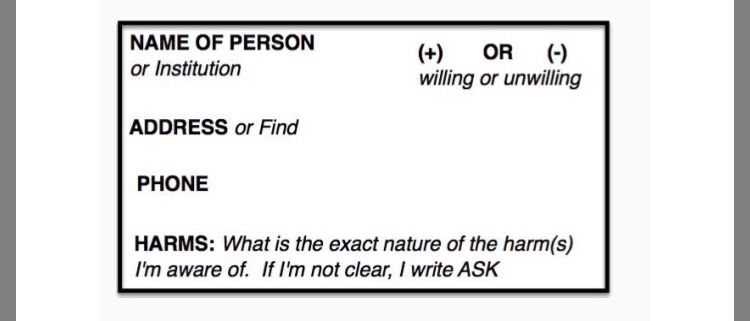
How do i make this list? I look at the harms I’ve identified in the resentment and sex inventories. Include any “take it to the graves” people to whom you’ve caused harm.
There are also amends that are due that are not found in any written inventory. These can be uncovered through daily prayer and meditation asking God to show you who you’ve harmed or give you an intuitive thought.
Make sure you are clear on who you’ve caused harm to; persons you stole time, trust or money from or persons you hurt either intentionally or unintentionally that did not show up in a resentment inventory.
There may be many people that you did not resent, but that you’ve harmed. Take this to prayer and meditation and ask God to reveal to you anyone you might’ve caused harm to even though you had no resentment in connection to them.
Use the process described in this workshop recording to create your list. Use index cards and not individual pieces of paper. Follow the format described on page 81 of the BBA workbook in order to fill out your index card.
No comments yet. Be the first to say something!